Strategy
You’re playing a deep cash game. Opponent opens on the button, you make the call from the BB. You hold T ♥ 9 ♠.

Flop comes 8 ♦ 6 ♦ 2 ♣. You check to your opponent. He has to decide between cbetting or not. On these types of low, semi-connected boards, you are expecting to see either a large bet (3/4 pot or higher) or a check. He checks back.

Turn is the J ♥, giving you an open ended straight draw. Your opponent has demonstrated weakness, and you assess that his range looks something like ace highs, low pocket pairs such as 33, 44 and 55, some middling hands like 8x and 6x and a lot of complete air, such as K ♦ T ♣ or Q ♥ 5 ♥. You on the other hand are completely uncapped - you can still have all of the sets and 2 pairs. Those are not many, however, and your opponent could have just turned top pair with KJ or AJ that checks flop. You want to bet, but not super huge. You pick the go-to sizing of every online regular - 75%. Villain calls.

The river is where the hand gets interesting. The A ♥ comes out. What now? Is this a good card to continue bluffing?
My student, who sent me this hand for review, wasn’t sure about it. This is what he wrote me:

He still decided to fire. Unfortunately, it didn’t work.

You can see in my student’s note for me that he had conflicting incentives in his head.
On one side, the idea that overcards are good cards to bluff on. And that’s true.
For example, the following print shows the EV of bluffing (measured in % of the pot) in the triple barrel line (Bet-Bet-Bet) BTN vs BB, when we compare river overcard runouts with non overcard runouts (these EVs were calculated using a database of 400 million hands of data across all stakes in online poker). Notice how overcard runouts (the ”Yes” row) have a much higher bluff EV for every bet sizing:

So yes, bluffing on an overcard is, in general, very profitable.
Why is that? Well, typically, when someone calls a bet on the turn, their calling range is mostly filled with draws and one pair hands, not overcards. On this board texture for example, a big percentage of the BTN’s calling range vs a turn 75% pot bet will be hands such as 98o, or K6s, or J4s. Maybe 77 sometimes. Then he will also have some QT or Q9 for a straight draw. We don’t expect our opponent to be calling too much with just overcards on the turn - hands like KQ or AQ will mostly fold (although some players might still call sometimes). When our opponent’s range doesn’t connect with the overcard, most of his range becomes even weaker - a hand that was 2nd pair on the turn now becomes a 3rd pair on an overcard. This contributes to our fold equity, because our opponent perceives it’s own holdings as way too weak to make the call.
On the other hand, my student also has the - correct - thought process: “I don’t connect with this card much. Sure, some bluffs here and there on the turn will have an Ace, but is that enough?”.
What he is doing here is a process that I call Range Tracking.
While hand reading is the ability to estimate your opponent’s range according to their actions, range tracking refers to your ability of tracking your own range across your actions. What are the hands you get to that scenario with? How many strong hands you actually have, and how many weak ones? Do you hit this card more than your opponent?
Range tracking is absolutely essentialy for high level performance in poker. You can absolutely crush opponents that operate at level 1 (what hand do I hold) with a level 2 thought process (what range do they have).
But if your opponents already operate at level 2 (meaning, most of your opponents are already trying to put you on a range), then you need to go one level above, which would be “what does it look like that I have?”. You become concerned with your own range at all times, estimating how you’re likely to be perceived by your opponents. How they perceive you will dictate how they will react to your actions, and how they will react to your actions should be the thing you use to determine which actions to take. By operating at level 3, you put yourself in your opponent’s shoes, you imagine what they expect you to have, and how they will react to that expectation, and then you use those estimations to recalibrate your own strategy.
My student had the right ideas in mind, but they conflicted. On one side you have the data saying that overcards are generally good cards to bluff at, on the other side you have an specific river runout where your range lacks top pair, and if your range lacks top pair, a medium bet that is designed to be the sizing you pick with exactly a top-pair type hand suddenly can look overbluffed. How can my opponent convince himself to fold 98o vs a 75% bet, which is essentially telling the story “I have top pair”, if almost no top pairs in my range would play this line this way? My understanding of population tendencies say that overcards are good to bluff, but this is an overcard and my intuition says a bluff doesn’t work here. Which should I follow?
My student decided to keep the aggression and he fired the 75% pot bet. That was, unfortunately, a mistake - but not for the reason you might think.
Bluffing with the 3/4 pot bet is indeed not super exciting on this runout. Across all the combinations of board texture high cards (which I call ‘broadway’ in my data filters) and whether the river was an ace or not, Triple low boards + Ace on River (exactly the case here), is the type of runout where bluffing is the least profitable, with only a 2% pot share - compared to a 7% baseline, and 4% when bluffing triple low boards on non-ace river runouts.

From these numbers, we can say that my student’s intuition was more or less correct on a card like this - across all the possible scenarios, this is in fact the worst one to bluff. Our range doesn’t contain many Ax combinations (because it’s a low board and we don’t bluff ace highs on low boards on the turn) and our opponent’s range can and should still have some Ax combinations (AK and AQ should call a lot at equilibrium), not to mention two pairs like A6, A2 and AJ, which we pretty much never have.
However, bluffing here was not the mistake. The mistake was trying to represent a class of hands he simply lacks in his range.
And this is where our intuition can betray us. It feels bad to bluff on the ace because we know we are not betting Ax on the turn and our opponent is calling some Ax on the turn. So it feels like we are going to get called too much if we bet a medium sizing that represents Ax. The story just doesn’t add up. And that’s true.
But the fix here isn’t to stop bluffing, it is simply to tell a different, more coherent, story.
We are not obligated to bet 75% pot here. In fact, this betsizing is almost not a part of equilibrium strategy on this card - reason being everything we already discussed about the ranges:
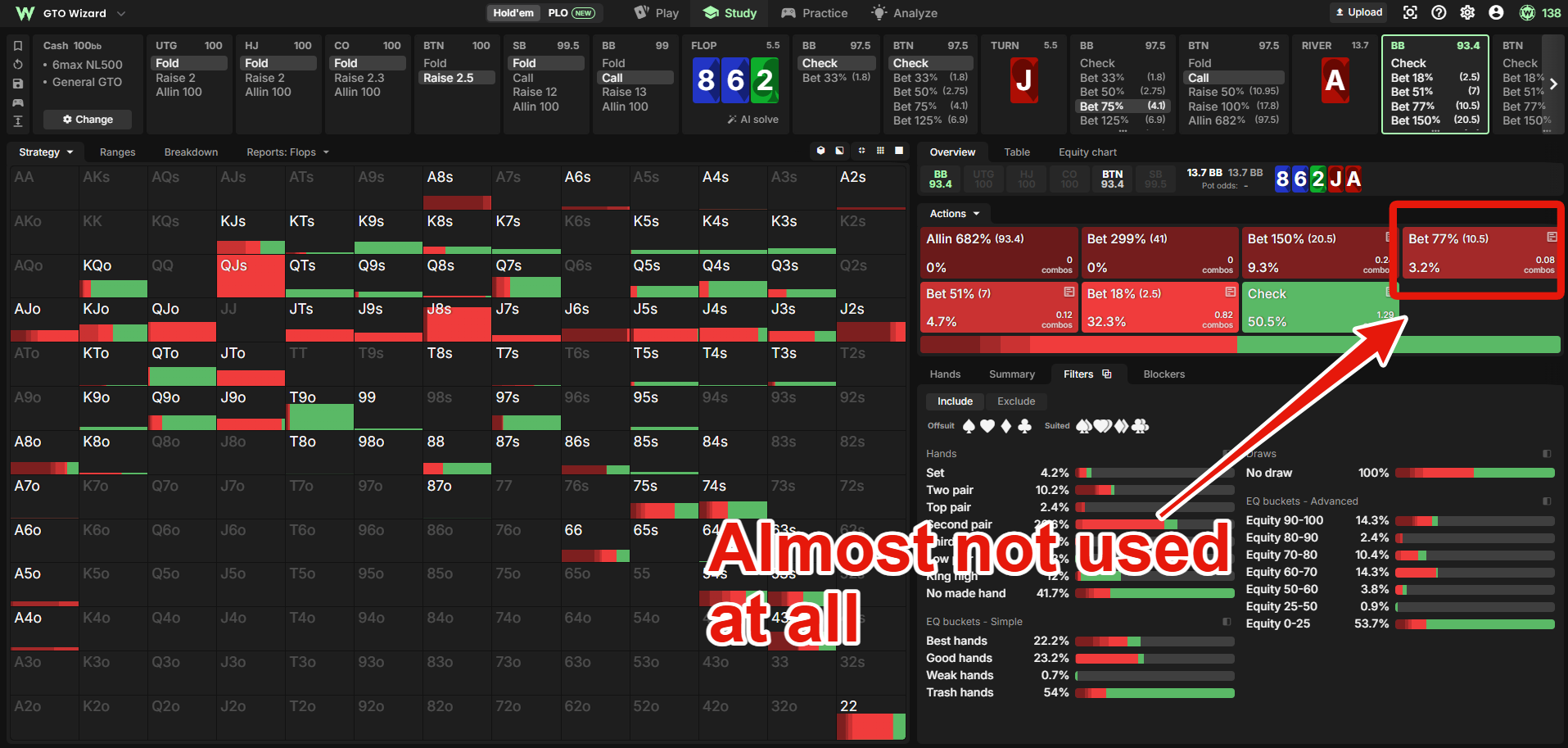
An overbet here would make much more sense. As we established from the flop, our opponent is never checking back with a very strong hand. He lacks the sets and 2pairs that we can fully have on the turn: 88, 66, 22, 86s, J8s, J6s. By the time the river is an Ace, those hands are still strong enough to overbet, and that’s a coherent story - as we can see above, solver likes to bet 150% pot on the river, exactly with the 2pair+ region.
And here is the best part about studying with data: it shows us not only that betting 75% of the pot on an ace is not so good, but most importantly which size can actually be good. And the answer is unequivocal: while a 3/4 sizing makes 2% of the pot in EV, a 1.5x overbet - exactly the sizing solver uses - makes 20% of the pot against the average regular:

That’s a super profitable bluff.
While our immediate intuition tells us that bluffing on a card that doesn’t connect with our range much can’t be an amazing idea, data shows that it is in fact an amazing idea - you just have to do it right. Range tracking allows us to see that we don’t get to that spot with hands that want to bet medium, and the data allows us to see that the sizing our range wants can be super profitable to bluff with.
My student’s mistake was picking a bet sizing that wasn’t coherent with his range construction. He had an amazing opportunity to print money with a bluff, on a line where regulars are significantly overfolding; but instead he chose a bet sizing that didn’t make sense with his range composition and got punished from an observant opponent.
This analysis illustrates what the modern era of poker strategy requires: first, it’s evident that the old-school ability to hand read your opponent and to be aware of your own range and image are still very much required. On top of that, the use of technology and mass data allows us to go deeper than our assumptions and intuition to study and dissect the exact behaviour of our opponents. By combining the use of observation and logical thinking with data science, we can stop guessing at what is the best play and we can discover new strategies that can unlock not-yet-seen potential for our winrate.
Do you enjoy these breakdowns with population data? If so, reply to this email with “Yes, show me the data!” and I’ll keep bringing interesting findings to improve your winrate.
Thank you for reading my friend. I’ll see you next time.
Saulo
Poker Made Simple Newsletter
A new post every monday to help you make more money at the tables. Completely for free.
